Autism: Different Perspectives
Key Takeaways
- There's no denying that autism looks very different from the inside than it looks from the outside. While some people might perceive autistic people as distant, uninterested, or socially disconnected, their internal experiences can instead be rich, complex, and deeply engaging.
- Many people with autism experience the world in unique sensory ways. They may, example, be fascinated by certain kinds of sensory stimuli. Some have strong emotional responses to small changes in the environment that are insignificant to others, but which create a large impact in their perception.
- Autistic thinking and learning styles vary widely. Some think and learn in ways that are consistent with normal variation, but others have unusual thinking and learning styles which can result in different perceptions and different approaches to solving problems. Some need material to be adapted to help them learn.
- Some autistic people have intense interests, often connected to how they think and learn and how they perceive the world. Others have a wide range of interests, although some may be unusual.
- Autistic behaviours often make sense when examined from the autistic perspective. However this is not easy and requires a lot of imagination.
Autism looks very different from the outside than it looks from the inside.
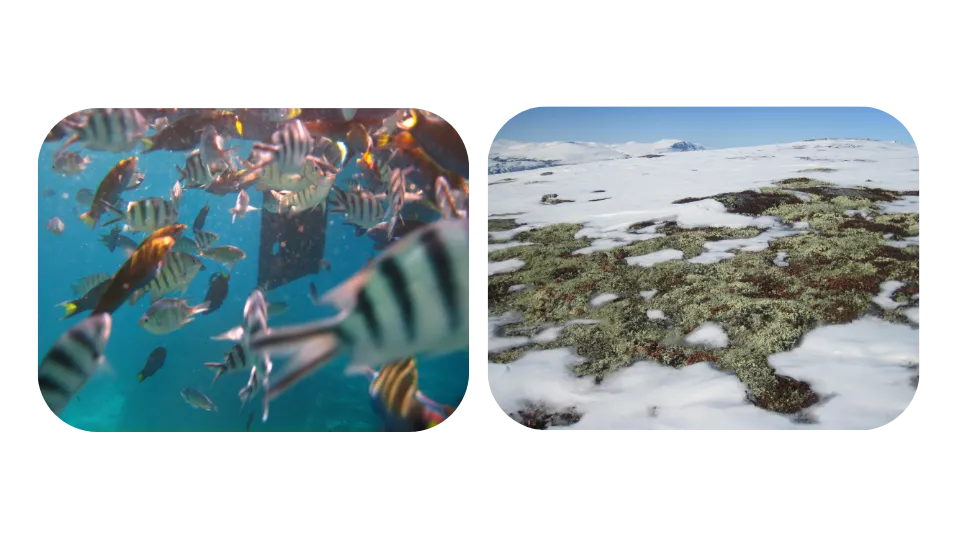
Consider the two pictures you see above. The first picture is of colourful tropical fish, which represents the variety of autistic experience and how fascinating autism is when you study it from the autistic perspective. The second picture, of snow-topped mountains, where the snow is melting to reveal lichen, represents what autism looks from the outside: cold, challenging, alienating for most people. There is little incentive to look more closely.
Autism from the Outside
Looking at autism from the outside, you might notice a lack of emotional connection and social communication, and a seeming lack of interest in others, focusing instead on their interests. People with autism can come across as cold and uninterested. You might see someone who doesn’t take pleasure from social chitchat and other social activities, or someone who mostly prefers solitary activities. They may have interests you find strange and uninteresting, and some autistic individuals may seem lost in their own world.
Communication may be very challenging too, because social skills are poor. Autistic people can be difficult to interact with, difficult to get to know and to build emotional connection with. Their responses may baffle, and their lack of social awareness can be frustrating, annoying, or even embarrassing at times.
The above looks at autism in general terms. There are autistic people who crave social connection and do their best to manage social chitchat, whereas others find social chitchat boring and pointless.
Autism from the Inside
Autism comes with difficulties with social interaction – and often there are difficulties coping with normal everyday life, even when nobody else is involved. These difficulties are very real and should not be minimised.
However, despite these difficulties, internal autistic experiences can be very rich, although they can be difficult for non autistic people to comprehend because they are so far removed from their own experiences.
Some autistic people have intense and unusual sensory experiences. Experiences such as ‘merging’ with objects, fascination with certain stimuli, synaesthesia - all experiences which are difficult to understand for those who don’t experience them:
Can you imagine the fascination of watching the sea or a waterfall, for instance? A fascination so strong it is difficult to tear yourself away.
Can you imagine losing yourself in how sunlight shines through the leaves of a tree?
Can you imagine losing yourself in the sound of a stream running nearby?
Can you imagine colours coming out of someone’s mouth when they speak, or people being perceived as having ‘tastes’ or ‘colours’?
Can you imagine number plates taking on fascinating shapes and colours, making a vehicle instantly recognisable?
All these are the kinds of experiences that some autistic people have that can make the world more interesting and difficult to explain to others who don’t experience this kind of thing.
Autistic people may have ‘Gestalt’ sensory experiences that make their experience of the world completely different. This can result in intense emotional reactions to small changes in the environment or if an object is not as it ‘should’ be. For example, paper with a bit torn off, or a pizza that is not perfectly cut can cause distress because they don’t ‘look right’. In fact they look completely different to how they ‘should’ look.
Some autistic people have unusual thinking and/or learning styles, which often result in different perceptions and different approaches to solving problems. However, sometimes this means that material must be adapted to how an autistic person learns.
Others, meanwhile, learn from material presented in standard ways, but may analyse it more deeply or see connections non-autistic people don’t see. Some autistic people have to put more effort into learning than most people because of how they process information: they have to spend time filling in gaps of information they missed when it was presented to them.
Some autistic people have intense interests or a series of interests, which are often linked to sensory issues and how they think and learn. Others may have a wide range of interests, which may be unusual. A few become ‘walking encyclopedias’.
The relationship with words can vary massively between autistic people. For some, words are fascinating; for others they are like a foreign language; while for others, finding words can be like trying to pick up jelly with your hands. Of course, many will have a normal relationship with words.
Not all autistic people have all the issues outlined above; the autistic experience is wildly different from one person to the next.
However, those whose experiences are more intense, and whose difficulties with connecting with the social world are more severe, may have their ‘own world’ that they retreat into. A world that is far more captivating and interesting than the social world.
Some autistic people have their ‘own world’ when young, but can lose it as they learn to appreciate the social world. Others dip in and out of both.
Autism is not always ‘a tragedy’
Not that long ago, a diagnosis of autism was seen as a tragedy. Indeed, in his paper ‘Don’t Mourn for Us’, Jim Sinclair asks non-autistic people not to grieve the person they expected their autistic child is or might become, but to learn to appreciate the child they have.
Although autism might look lonely and boring, that isn’t necessarily the case - although it can be. It depends on the autism of the individual and how much they crave social connection.
Autistic people can (and do) enjoy a richness of experience like anyone else. In fact, many experience the world around them in a much more rich way.
There are autistic people for whom their autism is a tragedy. This includes those who
- crave interpersonal connection, but their autism prevents them achieving it,
- those who are desperate to work, but who cannot obtain and/or maintain employment,
- comprehend what is going on around them, but who are unable to explain what they know and understand.
Once people understand the reasons behind what appears to be a lack of motivation or a lack of interest in people, they can start to see autism differently. I believe that those autistic people who do have insights into autism (and who believe that autism is a true disability, and not just a difference) could have a lot to contribute to ensure a better understanding of autism.
Autistic behaviours can look very puzzling from the outside, but generally make sense if you can switch perspective to looking from the inside. This switch of perspective is not easy and takes a lot of imagination, but can be very rewarding.
Don’t you think the variety and depth of autistic experiences is fascinating?